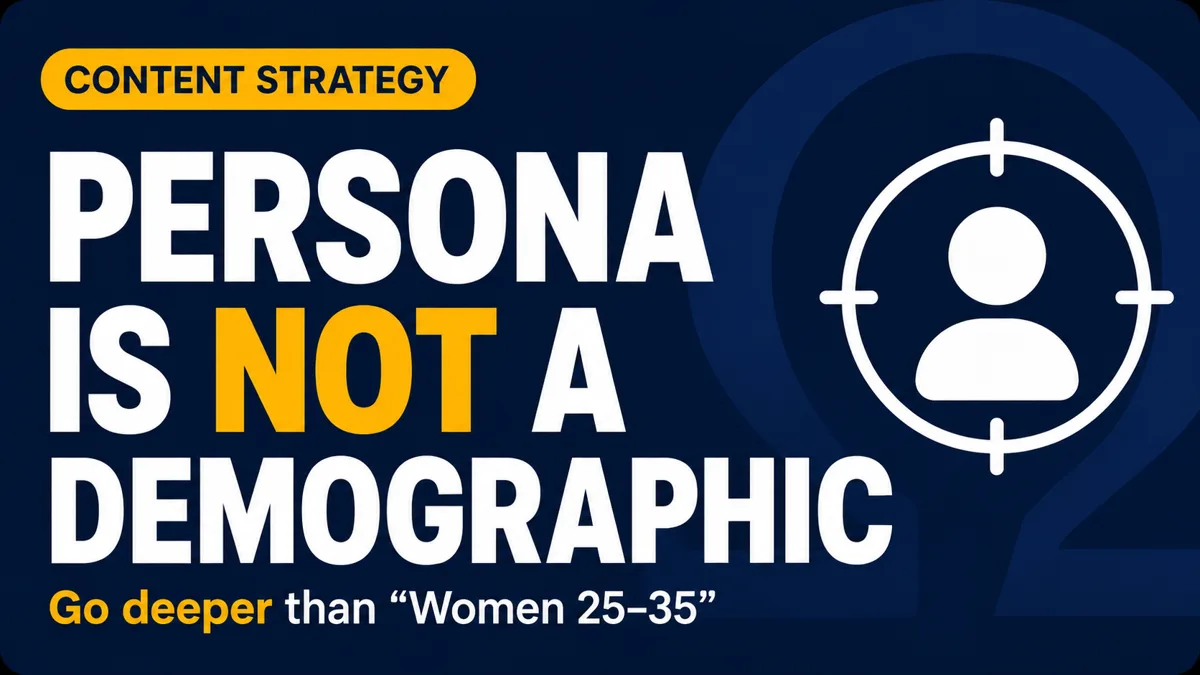
If your marketing persona is "women between 25 and 35," you do not have a persona — you have a demographic. Demographics do not buy; pains do. Go one level deeper, find the two or three sub-audiences inside your niche, and give each one its own message.
By Arnaud Utille — Founder, The Alpha Omega Hub · Published September 25, 2026
What is a real marketing persona?
A real marketing persona is a specific situation, not a label. It names who the person is, where they are, and what problem they are trying to solve right now — what triggered the need, what they are tired of, and what they already tried that failed. Age and gender are the packaging. The pain is the reason they stop scrolling and the reason they buy.
Why do age and gender tell you nothing about why someone buys?
"Women between 25 and 35" could mean a hundred different lives and a hundred different problems. Inside that same bracket you have mothers, women trying to lose weight, women who want to eat healthier, women simply maintaining a healthy lifestyle — completely different routines and priorities. A persona built only on demographics is too vague to write a real script for, which is why so much content ends up sounding like it was made for no one.
How do you dig into pains instead of labels?
Stop describing who they are on paper and describe what they are struggling with in real life. Take laundry. A woman who does laundry once a week has a completely different problem than a mother of two doing it several times a week. One wants convenience. The other wants relief from an exhausting routine. Same product, two different reasons to care — and speaking to both with one message means speaking to neither.
| Demographic | Real persona | |
|---|---|---|
| Description | Women 25–35 | Women 25–35 in Tampa who are new mothers |
| What you know | Age, gender | Situation, trigger, pain, lifestyle, awareness level |
| Message it produces | "We build websites." | "If you're a plumber in Tampa Bay considering a new website…" |
| Viewer reaction | Keeps scrolling | "That's me" |
How should you describe your audience?
A useful audience description includes age, gender, location, industry or customer type, problems, needs, lifestyle, and level of awareness — and it can usually be written in about ten words. The Alpha Omega Hub does not target "business owners." We target Tampa Bay B2C business owners aged 25–45 who value content. Location matters because the service is local and we film on site. B2C matters because short-form content is far more directly relevant for consumer-facing businesses than for many B2B companies. Age matters because owners between 25 and 45 usually have an established business, understand social media, and understand what content is worth — and because our own team is around 25 to 30, the relationship is simply easier to build than with an owner at 55 who is heading toward retirement.
How do you find the sub-audiences inside your niche?
Identifying the broad niche is not enough — you need the smaller pockets inside it. Inside almost any niche you can find two or three sub-audiences with completely different needs, pains and problems to solve:
- Women aged 25–35 who are trying to lose weight
- Women aged 25–35 living in St. Petersburg who are trying to lose weight
- Women aged 25–35 living in Tampa who are new mothers
Same broad audience, different lives. The goal is not to make the audience excessively narrow — it is to know which profiles exist so each one can be addressed through its own marketing angle. An angle is simply the reason your audience should care, and every sub-audience deserves its own.
Why does specificity make short-form content more relevant?
Because the more specific the message, the more the viewer feels directly addressed. Imagine a 35-year-old plumber in Tampa thinking about a new website. "We build websites" says nothing. "If you're a plumber in Tampa Bay considering a new website…" makes him recognize his profession, his location and his current need in one line. Nothing changed about the offer — only the specificity of the message. That is also why the pains you hear in a customer interview make better scripts than anything written from a spreadsheet. Turning those specific profiles into filmed short-form videos is exactly what we do at The Alpha Omega Hub: 10 tailored videos, first versions within 10 days after the shoot.
📚 Related Articles
❓ FAQ
Can a persona be too narrow?
The goal is not an excessively narrow audience. It is being able to name the different customer profiles inside your audience and speak to each one separately.
How many sub-audiences should I define?
Usually two or three per niche. Each one should have clearly different needs, pains and problems — otherwise it is the same audience twice.
Do I need a different video for every sub-audience?
Yes, or at least a different angle. One video per specific pain beats one video that tries to cover everyone and lands with no one.
Do you run the ads for this content?
No. We produce organic short-form vertical content for Tampa Bay B2C businesses. Media buying stays with you or your ads partner.
The Alpha Omega Hub is a short-form vertical content agency in Tampa Bay, Florida. We create customized short-form videos for local B2C businesses — strategy, concepts, scripts, filming, talent, and editing, all in-house.
Book a call